
There’s a lot of conversation in the People and Talent world about candidate experience. How do we attract the right people? How do we make the process feel human? How do we avoid the black hole? Important questions, and they get the attention they deserve.
There’s a moment that often gets glossed over though, and it might matter more than any of them: the stretch of time between when a candidate accepts an offer and when they actually show up on day one, plus everything that happens in the first 90 days after.
That’s the onboarding experience nobody talks about.
The gap between “yes” and day one
When a candidate accepts an offer, they’re at peak excitement. They’ve made a decision, they believe in it, and they’re ready to go. What happens next either reinforces that feeling or starts to erode it.
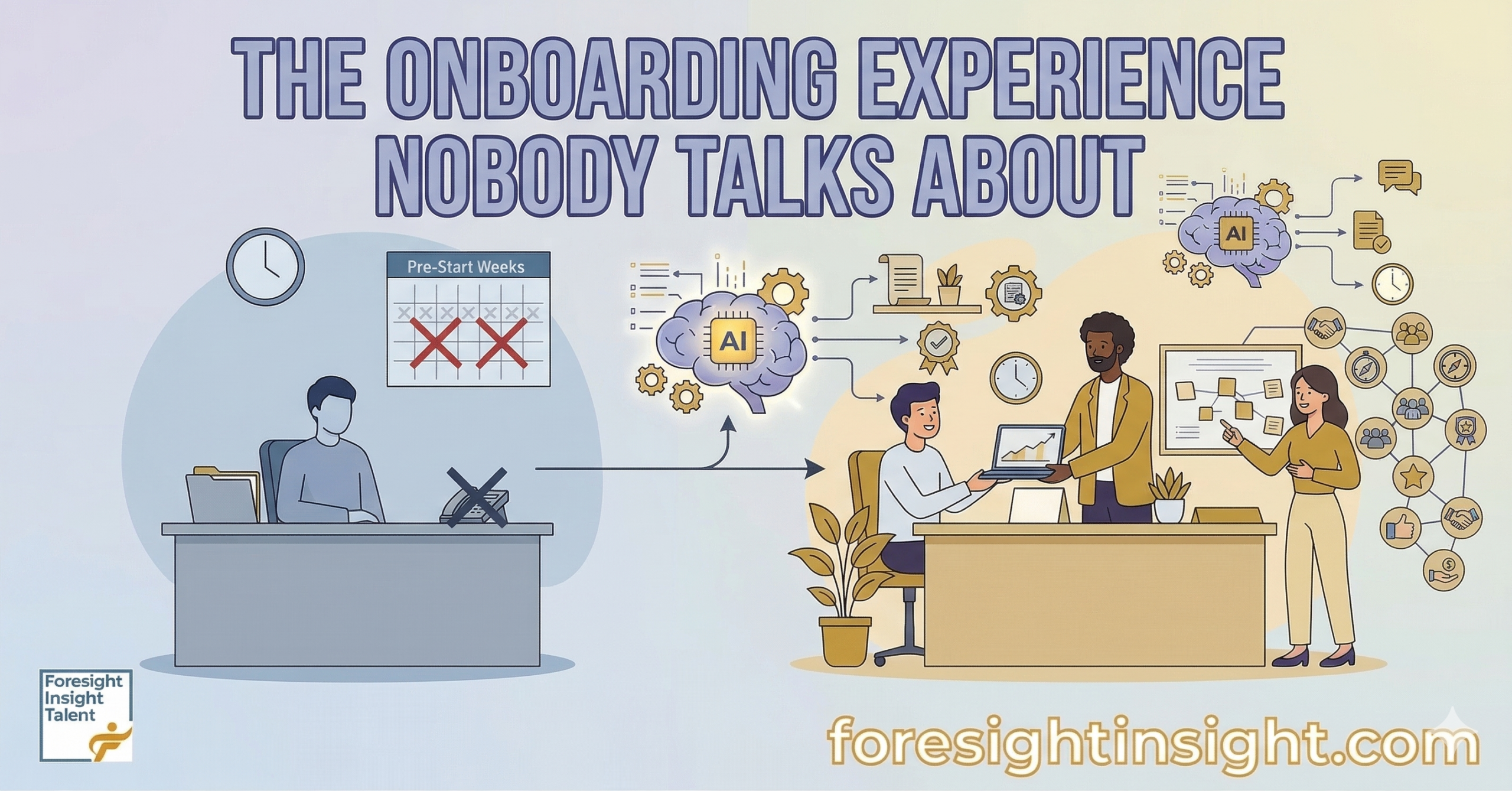
In a lot of organizations, the period between offer acceptance and start date is a dead zone. The recruiter has moved on to the next role. HR is processing paperwork. Nobody’s really owning the experience of the person who just said yes. The new hire is left to sit with their decision, sometimes for weeks, with little meaningful contact from the organization they’re about to join.
That silence sends a signal, even when no one intends it to.
The organizations that handle this well treat the pre-start period as an extension of the candidate experience. A personal note from the hiring manager. A heads up about what to expect on day one. An introduction to a future teammate, with context about why that person matters. Small gestures that say: we see you, we’re glad you said yes, and we’re ready for you.
Day one is a first impression, not a logistics exercise
Even when organizations invest in onboarding programs, there’s a tendency to treat day one as a checklist. Here’s your laptop. Here’s your badge. Here’s a deck about the company history. Please complete these compliance trainings by Friday.
That’s processing, not onboarding.
The best day one experiences I’ve been part of are the ones where the new hire feels genuinely welcomed rather than administratively received. They meet real people. They have real conversations. They leave the day with a clearer sense of why they made the right decision. The paperwork still gets done, but it’s not what the day is about.
The first 90 days are where retention is won or lost
Research consistently shows that a meaningful share of employee turnover happens in the first year, and a lot of that happens even earlier. People don’t leave because the job was hard. They leave because expectations were unclear, the manager was disengaged, the team never made room for them, or they simply never found their footing.
A strong onboarding program addresses those things on purpose. It defines what success looks like in the role and over what timeframe. It builds relationships beyond just the direct manager. It creates regular feedback in both directions. And it treats the new hire as a whole person rather than a headcount that needs to be ramped.
Where AI changes the picture
AI is reshaping onboarding in ways that go beyond automation. Personalized ramp plans that adjust based on what someone already knows. Adaptive learning paths that compress the time it takes to reach productivity. Continuous check-ins that surface friction in week two rather than month three. The companies getting this right aren’t just digitizing their old onboarding checklist. They’re rethinking the assumption that ramp time is a fixed, role-based constant.
Used well, these tools also free managers and People teams from the administrative layer of onboarding so they can focus on the parts that actually require human presence: the relationships, the context, the early read on whether someone is thriving or struggling.
What AI can’t do is replicate a manager who genuinely invests in a new hire’s first weeks. It can’t substitute for a team that makes space for someone new. And it can’t fix an onboarding experience that was poorly designed to begin with. Technology amplifies whatever process you already have, in either direction.
A question worth asking
If you asked your most recent new hires to describe their onboarding experience honestly, what would they say? And if you asked the ones who left in their first year, what would they say about where things went sideways?
Those answers are usually more useful than any engagement survey. If you’re thinking through how to build or rebuild your onboarding experience, I’d love to talk about it.