
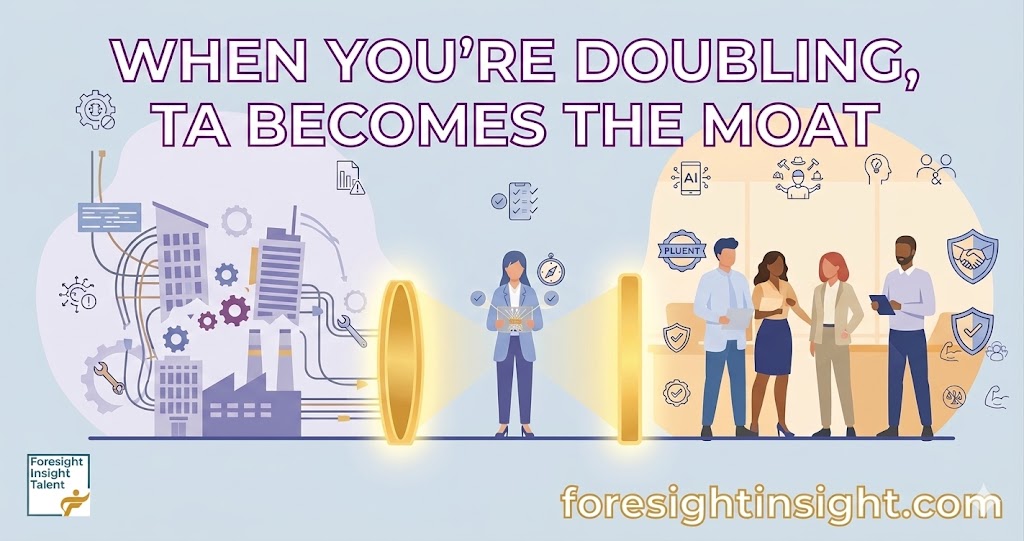
AI-Era TA, part 1 of 3
The compression is real, and it’s around you
In April, Daniel Kafer published a compression model for a 2,500-person US company. HR compresses 51%, going from five organizational layers to three. Marketing compresses 49%. IT Operations 47%. Finance Ops 58%. The numbers are sourced from McKinsey 2025, the Stanford HAI AI Index, Gartner, Workday Global Workforce Research 2026, and IESE Business School analysis.
A few days later, Kimberly Tan at a16z published hard data on enterprise AI adoption: 29% of the Fortune 500 and 19% of the Global 2000 are live, paying customers of leading AI startups. These are signed top-down contracts, deployed in production at scale.
The McKinsey 2025 State of AI Survey adds another data point: 32% of companies expect AI to reduce their workforce by at least 3% in the next year. Only 13% expect to grow. Companies cutting outnumber companies adding by 2 to 1.
If you’re running TA at a growth-stage company hiring 50 to 100 people in the next 12 months, none of this looks like your direct problem. You’re not compressing. You’re growing. The compression is happening around you, though, and it’s reshaping the talent market you’re hiring into. It’s possible that some of the senior people getting cut at scaled companies will be exactly who you want. However, many won’t, because scaled-company seniority often means deep specialization in a single layer of a larger machine. Growth-stage companies need multi-hat operators, which is a different skill set entirely. Your problem is whether your TA function can tell the difference, fast enough to absorb the right people without diluting your talent density on the way through.
Why doubling on the old frame fails
The metrics most TA leaders still report (time-to-fill, cost-per-hire, offer acceptance rate, recruiter productivity) made sense when growth-stage hiring meant adding incremental headcount on top of an existing base. Those metrics assume volume, redundancy, forgiveness, and predictable growth. Compression and high-velocity growth strip away all of that.
A 5% bad-hire rate at 30 hires is one or two people you can manage out. A 5% bad-hire rate at 100 hires is five people, which translates to real dilution of talent density at exactly the moment you need to be sharpening it. There’s no surplus headcount to absorb the gap, and no slack in the system to work around a B-player in a critical seat. A bad hire in 2022 cost you a slow ramp. A bad hire in 2026, in a doubling AI-native company, takes a seat that should have gone to someone twice as effective.
Johnny Campbell, CEO of Social Talent, told SHRM in March that the “low hire, low fire” pattern that defined 2025 has become the new baseline. David Manaster of ERE Media described 2026 as a year of wrenching change for TA organizations as teams consolidate and repetitive work moves to AI.
For growth-stage TA leaders, the immediate implication sits in the talent pool. It’s increasingly composed of people who survived compression at larger companies. The bar gets harder, the diligence gets sharper, the cost of mistakes compounds, and the time to detect a problem shrinks.
The deeper reframe: speed and quality are independent axes, not opposite ends of a tradeoff. The old metrics treat them as a tradeoff because the signal in most hiring funnels is ambiguous, so interviewers compensate by slowing down or settling. Clean signal lets velocity and bar move together. That’s the operating shift growth-stage TA functions need to make to absorb compressed talent without diluting density.
What talent density means at 100 to 200 people
Everyone still wants A players. What “A player” means has shifted. The bar at growth stage has gotten harder along multiple dimensions, all at once.
AI fluency is now table stakes. A candidate who can’t operate AI as a force multiplier costs you compounding productivity gaps over time, especially at an AI-native company where the product itself depends on AI literacy. Candidates have to operate autonomously, because growth-stage companies don’t have the management bandwidth to ride people. They have to work across adjacent domains, because lean teams have fewer specialists to hand off to. They have to handle ambiguity well, because growth-stage decisions move faster and with less consensus-building than they will at any later stage.
That’s what A player means in 2026. The work has changed, and the people who can do it are a different population than they were two years ago. Each of those filters cuts a meaningful slice of candidates who would have made the cut on credentials and pedigree alone. The pool of people who clear all four at once is genuinely small.
Korn Ferry’s 2026 TA trends report lands the same point from a different angle. 84% of talent leaders plan to use AI in 2026. 73% say the skill they need most is critical thinking and problem-solving. AI skills rank fifth on that list. The TA leaders closest to the work understand that judgment is the constraint that matters. Tooling is secondary.
TA as the moat when you’re doubling
When you’re doubling on a lean TA team in a compressed market, TA becomes the function that determines whether the company doubles well or dilutes. Growth is what creates the moat.
Companies that hire well during a doubling event come out the other side with stronger talent density than they started with. Companies that hire by old metrics dilute their team and stall, because weak hires take longer to identify and cost more to remediate when there’s no surplus headcount to absorb the gap. The hiring decisions made between 100 and 200 people set the cultural and capability baseline for everything that comes after.
McKinsey is making a related argument from inside the engineering function. In their April 2026 piece on redesigning the technology workforce for the agentic AI era, they wrote that companies hiring “for volume rather than expertise” risk inflating costs without growing impact. That’s the moat thesis applied to one function. Extend it to a whole growth-stage company doubling in 12 months and TA owns the lever.
The top-performing TA teams have already figured this out. GoodTime’s 2026 Hiring Insights Report, based on more than 500 US TA leaders, found that 90% of companies missed their hiring goals. The top performers are scaling output without adding or cutting headcount, by redesigning workflows around AI orchestration. CEO Ahryun Moon framed the real challenge bluntly: the hiring problem in 2026 is about redesigning how hiring work gets done, full stop.
The strategic implication for TA leadership at growth stage: TA earns its seat at the strategy table during the AI shift, or the function gets relegated to a hiring desk that backfills reqs on demand. Both happen in the market right now. The differentiator is whether the TA leader can articulate the stakes in language the CEO already speaks.
Compliance is the operating muscle that scales with you
The legal weight on AI in hiring is real at 100 people, with less day-one urgency than at 2,500. The operating muscles you build now scale with you.
In the EU, AI used in employment decisions is classified as high-risk under Annex III, Category 4 of the EU AI Act. The deadline for full high-risk obligations is August 2, 2026. The Digital Omnibus proposal would push that to December 2027, but the second political trilogue ended without agreement on April 28. If you have any EU contractors or hire any candidates based in the EU, the regulation applies. Penalties top €35M (about $41M USD) or 7% of global turnover for high-risk violations.
In the US, Mobley v. Workday is the bellwether. In March 2026, a federal judge let the ADEA claims proceed and rejected Workday’s argument that the law doesn’t extend to applicants. The certified collective covers anyone over 40 who applied through Workday since September 2020. Under the court’s “agent” theory, AI vendors can face direct discrimination liability, which extends exposure across the entire stack including any ATS-embedded AI features in active use.
Here’s the gap, from PwC’s research: only 24% of enterprises using AI in HR have started formal compliance prep. 87% are already using AI in hiring. Growth-stage companies are disproportionately in the second number and not yet in the first. The ones that build vendor diligence, human oversight, bias monitoring, and decision logging into the function early carry that infrastructure into the next stage of growth without the retrofit cost.
Same operating muscles, different time horizon.
What this means for TA leaders at growth stage
If you lead a TA function at a growth-stage company in 2026, you have two paths.
Path one: keep optimizing the funnel that worked when the company was 30 people. Report time-to-fill and cost-per-hire to the executive team. Add AI tools to the existing stack. Hope the metrics that worked when you were hiring 30 people a year still apply when you’re hiring 100. They won’t.
Path two: reframe the function around density and AI fluency before the doubling event lands. Build the operating muscles the compliance reality will eventually demand. Translate every TA conversation with leadership into the language of business risk and strategic moat. Become the person at the table who sees what’s coming.
The leaders who pick path two get pulled into the strategy room when the next round of compression hits the company. The leaders who stay on path one watch the function get pushed down the org chart.
That’s the trade. TA at the doubling point is the function that decides whether a company makes it through growth with a stronger team or a diluted one. Most TA leaders haven’t yet realized that’s the job description.
The next post in this series gets concrete on what that scorecard looks like at growth-stage scale.
The long arrow
The CEOs who figure this out first will pay a premium for TA leaders who already see it. The rest will outsource the function to a tool and learn the hard way that tools don’t have judgment, and class actions don’t have patience.
The arrow from here is sharper than most people are sitting with. Korn Ferry’s David Cheesewright projects that by 2036, many companies will generate tens of millions of dollars in revenue per employee. Each new hire will be 100 times more valuable than today. Every wrong call hits harder. Every right call compounds longer.
Compression is a decade-long arc that’s already started. For growth-stage companies, the play is to absorb the talent that gets compressed out at scaled companies while protecting your own density on the way through. TA either becomes the function that protects density during growth, or it becomes the bottleneck that lets density slip away.