
AI-Era TA, part 3 of 3
What stopped working
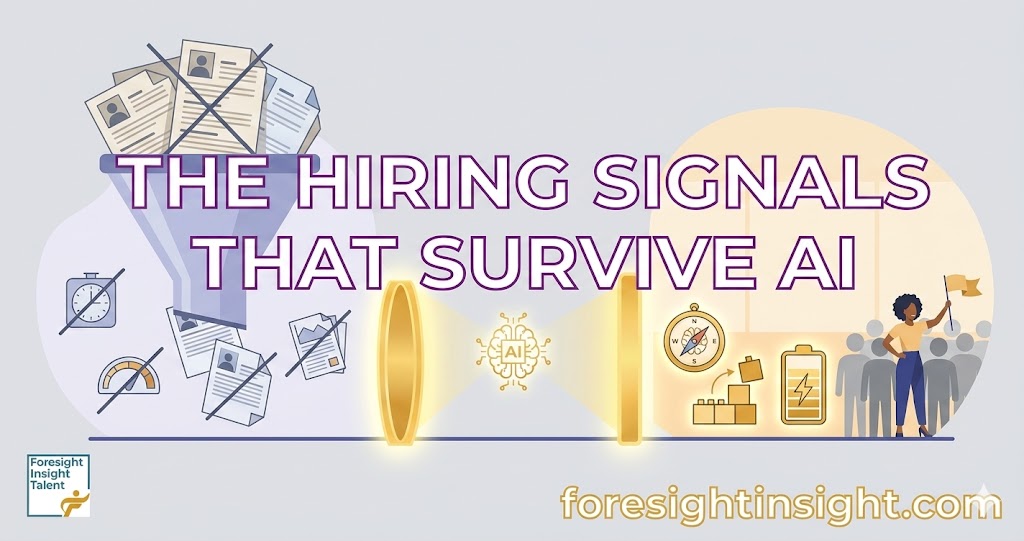
The hiring signals most TA functions still optimize for stopped predicting performance somewhere between 2023 and 2025. Seniority. Volume of personal output. Process mastery. Tool specialization. Each of these used to track loosely with whether someone could do the job. None of them do anymore, because AI has changed what the job actually is.
Adriano Herdman has compiled some of the clearest insights on this shift, and the data points he tracks are the right starting place. 65% of design execution at leading teams is now absorbed by AI. 80% or more of the code at AI-first companies is written by agents. Vision cycles that used to run 2 to 5 years are collapsing to 3 to 6 months. The work itself is different, which means the signals you’d use to predict success at the work have to be different too.
The first two posts in this blog series argued that TA becomes the moat in a doubling growth-stage org, and that the scorecard you measure determines whether the moat is holding. This post is about what you actually look for through that lens.
The signal shift, function by function
Engineering. The old signal was volume of code written personally and depth of language or framework specialization. The new signal is quality of agent steering and review judgment. The strongest engineers in 2026 review AI-generated code with intention. They catch hallucinated APIs, deprecated methods, and subtle complexity issues. They have a workflow for review, not a gut sense. A recent KORE1 piece on hiring engineers in 2026 names this directly: the strongest signal is a candidate who pushes back on AI output, not one who pastes it.
Design. The old signal was polished mocks and process mastery. The new signal is shipping directly in code alongside engineers, and exercising judgment about direction over execution. Design execution is becoming a commodity. Design judgment is what’s scarce.
GTM. The old signal was manual pipeline volume and personal hustle. The new signal is the ability to build AI-augmented outreach systems that compound rather than burn out. The strongest GTM hires in 2026 don’t outwork their peers. They build systems that outwork them.
All roles. Speed of learning over depth of history. Comfort operating without a playbook. The half-life of any specific tool or methodology is now short enough that a candidate’s ability to absorb new ones quickly matters more than their existing fluency in any one of them.
The five signals that earn a spot in the interview process
Skip the long competency list. At growth stage, five signals do the predictive work. They map directly to the four “A player” filters from Post 1 and the Quality of Hire composite from Post 2.
1. AI Integration. Does the candidate operate AI as a force multiplier in their day-to-day work, or do they just use it ambiently? The interview signal: ask for a specific recent example, this week or last, of where they reviewed AI-generated output and pushed back. The strong answer has three properties. It’s specific. The reason is technical and concrete (“it used a deprecated API,” “it hallucinated a method that doesn’t exist on that class”). They describe a workflow, not a gut sense. The weak answer pauses, hedges, or says “it just didn’t feel right.”
2. Judgment. Can the candidate evaluate outputs (their own and others’) against a standard they can articulate? In an environment where AI generates the average view of any topic instantly, original judgment is scarce and high-leverage. The interview signal: present an ambiguous scenario, ask for a recommendation, then probe the reasoning. The strong candidate has beliefs they can defend. The weak candidate reflects consensus or hedges to whatever you seem to want to hear.
3. Ambiguity Tolerance. Does the candidate build structure where there isn’t one, or wait for it to be handed to them? Growth-stage companies don’t have the management bandwidth to spec everything in advance. The interview signal: ask about a time they operated without a playbook. The strong answer describes the experience positively, as something they sought out. The weak answer describes it as something they endured.
4. Learning Speed. What’s the rate at which they pick up new domains, tools, or skills? In a world where the underlying tooling shifts every six to twelve months, learning velocity matters more than current mastery. The interview signal: ask what they’ve changed their mind about in the last year. The strong answer is specific and substantive. The weak answer either has nothing or names something trivial.
5. Independent Thinking. Does the candidate hold beliefs they can defend, or default to consensus? The interview signal: ask for an opinion they hold that they’ve had to defend recently, in a meeting, in a review, or to a peer. The strong candidate has one ready and walks through the defense without performance. The weak candidate either can’t produce one or produces something so milquetoast it’s clearly performative.
How to weight the signals
Not every candidate needs to score top marks on all five. The relative weighting matters more than the absolute scores.
A candidate who scores strong on Judgment and Learning Speed but moderate on AI Integration is usually still worth hiring. They’ll absorb the tooling fast, and the hard signals (judgment and learning velocity) are already in place.
A candidate who scores strong on AI Integration but weak on Judgment is a risk. They produce a lot of mediocre output very fast. In a compressed org with no slack to absorb that kind of hire, the math doesn’t work.
A candidate who scores strong on Independent Thinking but weak on Ambiguity Tolerance often turns out to be a brilliant individual contributor who struggles in a startup environment. Useful to know before the offer.
The framework’s job is to make the trade-offs visible so the hiring team can have an honest conversation about whether the signal pattern matches the role.
The candidate archetypes worth prioritizing
Three archetypes show up consistently in the candidates who clear the bar at growth stage.
Block Shape. Broad foundation across multiple disciplines, with depth that comes from systems thinking rather than narrow specialization. Block Shape candidates are high-leverage at growth stage because lean teams reward people who can move across adjacent domains.
Deep T. One area of real depth plus enough range across adjacent areas to operate cross-functionally. Deep T candidates are the workhorses of an AI-mature growth-stage company. They have a craft they own, and they don’t need a specialist to lean on for anything outside it.
Craft New Grad. Early-career candidates with high taste, fast learning velocity, and AI fluency that compensates for limited tenure. Worth a category of their own because the AI-native generation is producing senior-quality output faster than the traditional career arc would predict. The hiring managers who write off Craft New Grads on tenure alone will lose them to companies that don’t.
These archetypes are sharper than “hire A players” because they tell hiring managers what to look for in real candidates rather than just how high to set the bar in the abstract.
The fraud problem the signals don’t solve on their own
The five signals only work if the person showing up to the interview is the same person who’ll show up on day one. AI-driven candidate fraud has made that assumption shaky.
Gartner found that 59% of hiring managers suspect candidates of using AI to misrepresent themselves, and 62% of recruiters say candidates are getting better at faking faster than detection systems are catching up. Checkr reported that 23% of companies have already encountered identity fraud among new hires.
The defensive posture has four pieces. Build rubrics around demonstrated work rather than credentials, since demonstrated work is harder to fake than a polished resume. Train recruiters and interviewers on the current state of candidate fraud, because the threat surface changes every six months and the people closest to the process need to recognize the patterns. Verify identity at the right gate, before the technical loop, where the cost of catching a problem is still low. Most companies verify at offer, which is too late. And require live, unscripted technical demonstration somewhere in the loop, because synchronous problem-solving is still the hardest signal to fabricate.
This is where the candidate authenticity metric from Post 2 connects directly to the signals. The metric measures whether the verification gate is working. The signals measure whether what you’re evaluating is real performance or surface-level mimicry. Both have to hold for the hire to land.
Calibration is what makes any of this real
A rubric is only as good as the calibration cadence behind it. Humanly’s 2026 research on AI recruiting benchmarks names this clearly: the quality benchmark that actually predicts hiring success is calibration. Do different recruiters and interviewers make the same call when shown the same evidence?
The mechanics of calibration are well-understood and rarely executed. Run a 30-minute calibration session weekly for the first eight weeks of any new role family. Pull recent edge-case candidates. Have each interviewer score independently. Reveal scores together. Force a discussion of the discrepancies. The discussion is where the rubric gets sharp.
The drift signals to watch for: pass-through rates that change without an underlying shift in the candidate pool, score distributions that compress or widen, decisions that get faster while rationale gets thinner. Recent research on structured interviewing found that switching to a properly calibrated structured format reduces bad-hire rates by 30 to 50%, with implementation costs typically under $20K for a 40-role function and a 5:1 first-year ROI.
Most growth-stage TA functions either don’t run calibration or run it once at kickoff and never again. The leaders who run it aggressively in the first two months catch signal drift before it shows up in Quality of Hire twelve months later. That’s the operating difference between a function that compounds talent density and one that hires quickly without knowing if it’s hiring well.
The series in one frame
Post 1 made the case that TA becomes the moat in a doubling growth-stage org, because the cost of a bad hire compounds when there’s no surplus headcount to absorb it.
Post 2 named the scorecard that proves whether the moat is holding: Quality of Hire, 90-day performance attainment, hiring manager satisfaction, candidate authenticity, and time-to-fill in its demoted role as a hygiene signal.
This post named the signals that determine what gets through the funnel: AI Integration, Judgment, Ambiguity Tolerance, Learning Speed, and Independent Thinking, evaluated through structured interviews with weekly calibration in the first eight weeks of any new role family.
The three pieces work as one system. The moat argument is the strategic frame for why TA matters at growth stage. The scorecard is the lens you measure through, with five metrics calibrated to growth-stage scale. The signals are what you look for when you measure. The calibration cadence is what keeps any of it real over time. Run all four together and a TA function at growth stage produces compounding talent density. Run any of them in isolation and the function reverts to optimizing the wrong thing.
The TA leaders who internalize this in the next 18 months will be the ones who get pulled into the strategy room when the next compression event hits their company. The ones who don’t will watch the function get pushed down the org chart while every other function gets compressed around it.
The work is right there. The question is who picks it up.