
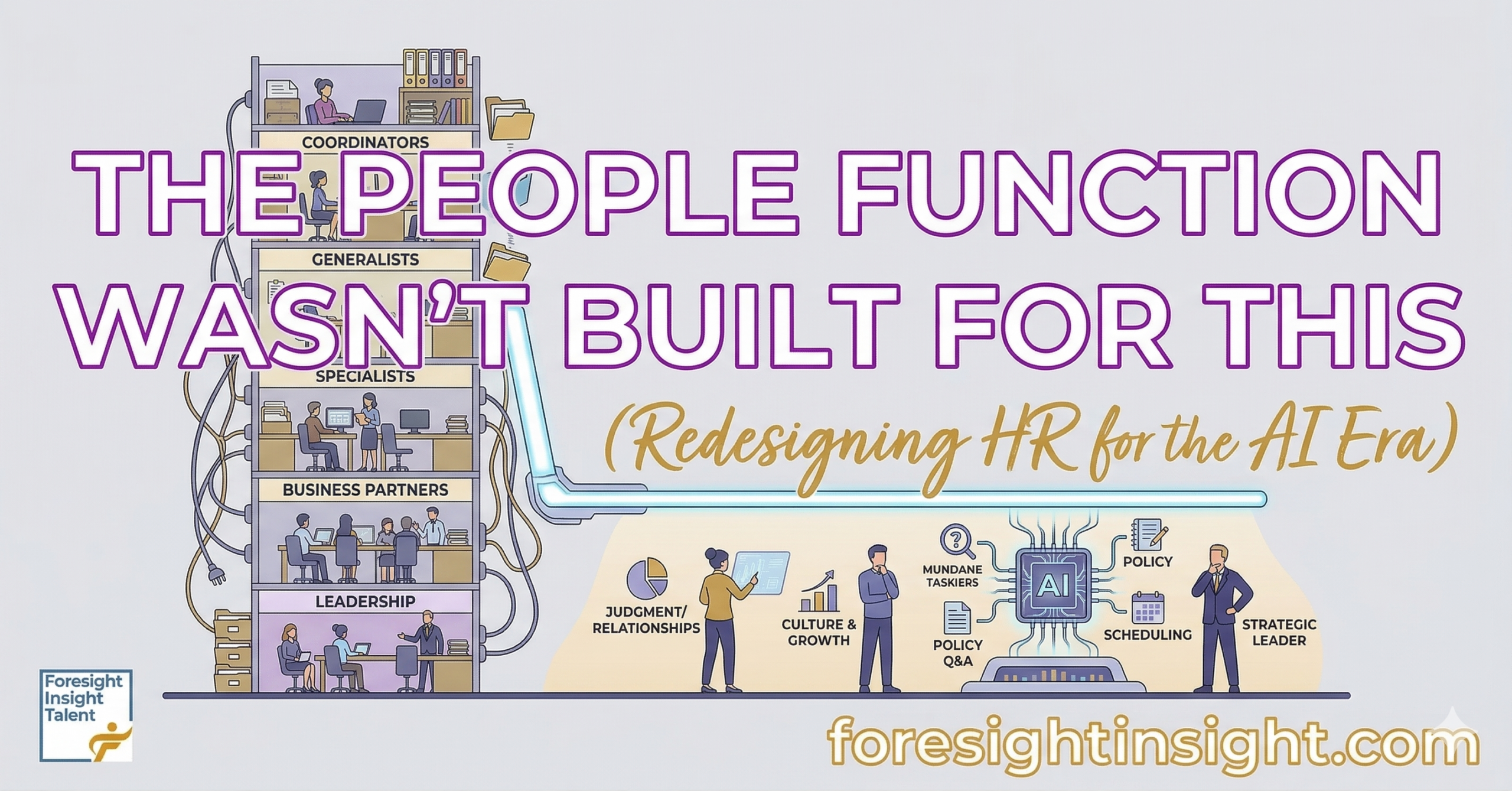
Most People teams are trying to bolt AI onto an operating model designed for a different era. New tools, same org chart. New dashboards, same five layers. New vendors, same assumptions about who does what and why.
It isn’t working, and the people paying close attention already know it.
The shape of a traditional People function reflects a world where information was expensive to move. You needed coordinators to schedule, generalists to field questions, specialists to pull reports, business partners to translate between leadership and the org, and someone sitting on top of all of it. Five layers, sometimes six. Every one of them existed because there was no faster way to get information from one part of the company to another.
That constraint is gone.
Wisq’s agentic HR generalist handles policy questions, leave inquiries, and case triage end-to-end. A real portion of Tier 0 and Tier 1 work, resolved without anyone on the People team touching it. Metaview captures and structures interview intelligence that used to live in a recruiter’s head or a scattered set of scorecards. Ashby turns pipeline reporting into something closer to a live operating system than a weekly deck. None of this is theoretical. It’s shipping, in production, at companies right now.
When the constraint goes away, the structure built around it stops making sense.
Here’s where I think most People leaders are getting stuck. The question we keep asking is how to use AI to do our current work faster. That’s the wrong question. The real one is whether the current work should exist at all, in its current shape, done by the people currently doing it.
A rebuilt People function looks different in ways that are uncomfortable to say out loud. The transactional middle compresses hard. Case routing, policy Q&A, onboarding admin, compliance tracking, status reporting, most of the work that exists to move information around can run without human hands on it. What’s left is a smaller team doing harder work. Judgment calls. Relationships. Culture. The decisions that carry real legal and human weight. The strategic work that actually shapes how a company grows.
That isn’t a headcount exercise. It’s a function redesign. And the distinction matters, because leaders treating this moment as a cost-cutting opportunity are going to end up with a shrunken version of the old thing. Leaders treating it as a redesign are going to end up with something that looks materially different two years from now.
The harder part: you can’t redesign a function from inside the operating rhythm of that function. Performance cycles, open reqs, open enrollment, the daily noise of the job doesn’t leave room to step back and ask whether any of it should exist in its current form. That’s why most of this rethinking happens under pressure, after a layoff or a leadership change, when the cost of waiting has already been paid.
The companies getting ahead of the compression curve are the ones asking the question now, while they still have options. What would we keep? What would we cut? What wouldn’t exist at all if we were building this function from scratch, with the tools available today?
Most People leaders haven’t sat with those questions yet. The ones who do, early, will shape what the function becomes. The ones who wait will have it shaped for them.
The function that manages change is the one being changed. That’s the work in front of us.